
Field report 4 min read
Beyond Food Aid: Building Sustainable Livelihoods in South Africa
SOUTH AFRICA’S HUNGER CRISIS DEMANDS MORE THAN JUST FOOD AID South Africa’s hunger crisis demands more than just food aid. Every day, Operation Hunger confronts the harsh reality of malnutrition: from stunted children to families forced to eat nutrient-poor food. These aren’t iso...
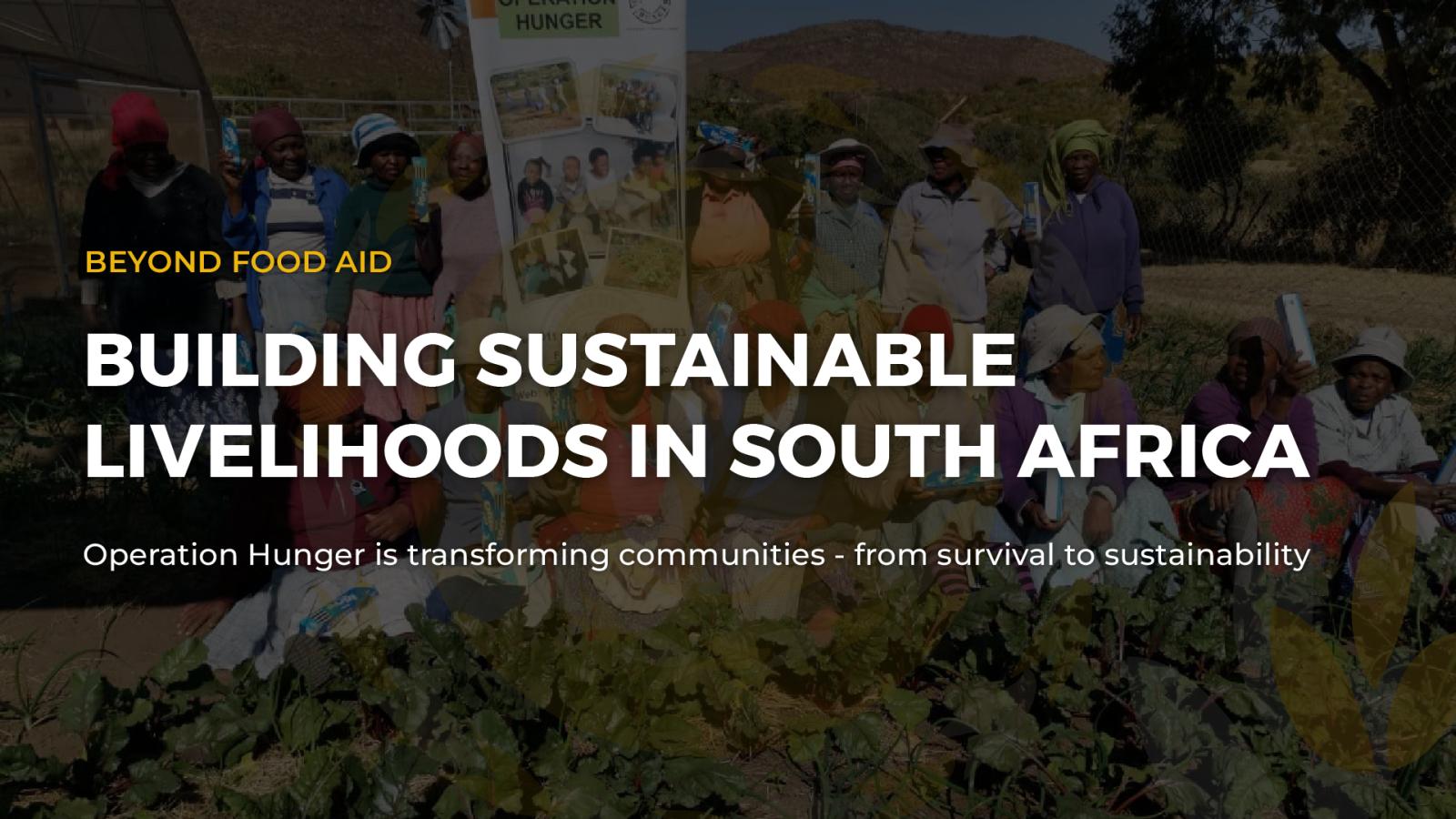
SOUTH AFRICA’S HUNGER CRISIS DEMANDS MORE THAN JUST FOOD AID
South Africa’s hunger crisis demands more than just food aid. Every day, Operation Hunger confronts the harsh reality of malnutrition: from stunted children to families forced to eat nutrient-poor food. These aren’t isolated problems; they’re symptoms of a broken system that consistently fails those marginalized by geography, gender, income, or history.
But we know the solution. Our development programs aren’t just charity; they rebuild infrastructure. They are the engine of long-term, systemic transformation. We don’t just respond to hunger; we build lasting pathways out of it.


 THE PROBLEM IS DEEPER THAN HUNGER THE PROBLEM IS DEEPER THAN HUNGER
  1. Persistent Poverty
 Millions of households remain trapped in poverty, lacking stable income or meaningful opportunities. The World Bank projects 63.5% of South Africans will live in poverty by 2025, with the headcount reaching 41.8 million by 2027. Even those who work often earn too little for nutritious food, school fees, or savings. This widespread underemployment and lack of inclusive growth deeply erodes household resilience.
2. Limited Access to Education and WorkEducational disparities, particularly in rural and low-income areas, severely limit future prospects. South Africa’s official unemployment rate hit 32.9% in Q1 2025. For youth (15–34), it’s a staggering 46.1%. Education is key: those without a matric qualification face 51.6% unemployment, while university graduates see it drop to 23.9%. Without quality education and job skills, many young people are excluded from formal employment, stifling individual potential and broader community development.
3. Entrenched Gender and Racial DisparitiesInequality is profoundly racialized and gendered. Women and Black South Africans, particularly in historically disadvantaged regions, disproportionately bear the burden of food insecurity and unpaid care work. In Q4 2024, Black African women faced the highest unemployment rate at 38.6%. Land ownership also remains skewed: Black South Africans, over 80% of the population, own less than 9% of agricultural land, and fewer than 13% of female-headed households formally own land.
4. Unequal Access to Basic ServicesMany households lack reliable access to clean water, healthcare, sanitation, transportation, and local food markets. The 2024 General Household Survey found nearly 1 in 5 South Africans (19.9%) lacked safely managed sanitation. While 71.8% of urban residents have access to safe water, only 36.7% of rural populations do. Access to free basic water declined nationally from 38% in 2014 to just 16% in 2023. This lack of infrastructure imposes significant financial, physical, and emotional costs on the poorest.
5. Overall Food InsecurityMalnutrition, food insecurity, and chronic hunger directly result from deep social, economic, and political inequities. The National Food and Nutrition Security Survey (2021–2023) reveals over 63% of South African households—some 20 million people—are food insecure. Crisis scenarios are especially severe in provinces like North West.
OUR SOLUTION: BUILDING SUSTAINABLE LIVELIHOODSOperation Hunger’s development model is a locally-grounded, systems-oriented approach that tackles the root causes of food insecurity. We build lasting solutions that:
Broaden income streams for vulnerable households, especially women and youth.
Improve food systems and markets for affordable, accessible, local nutrition.
Expand sustainable livelihoods through agriculture and small enterprises.
Build community safety nets to reduce risk and strengthen resilience.
Protect natural resources essential to long-term food production.
Ensure fair access to essentials like food, work, education, and dignity.
IMPACT IN ACTION: OUR COMMUNITY-OWNED SOLUTIONSSkills Training & Enterprise Development
Empowering youth and women to launch or grow food-focused micro businesses.
Agroecological Food Production
Biodiverse gardens, tunnel farming, and permaculture that boost local nutrition and protect biodiversity.
Nutrition Literacy & Health Education
Training parents, caregivers, and schools on healthy diets and food choices.
Self-Help & Savings Groups
Enabling households to build financial resilience, access emergency loans, and invest in their futures.
Local Market Linkages
Connecting smallholder producers directly to buyers, reducing waste and increasing income.
The ripple effect: investing in lasting changeEach successful project creates powerful ripple effects:
- Better child nutrition leads to better school readiness.
- Increased household income means lower reliance on aid.
- Women-led agriculture empowers entire communities.
- Diversified food production fosters climate adaptation.
 Join us: invest in systemic change
 Operation Hunger’s development model is a locally-grounded, systems-oriented approach that tackles the root causes of food insecurity. We build lasting solutions that:
Join us: invest in systemic changeOperation Hunger’s development model is a locally-grounded, systems-oriented approach that tackles the root causes of food insecurity. We build lasting solutions that:
Monthly Donors
You help families move from relief to resilience – one meal, one garden, one enterprise at a time.
Corporate Funders
You’re making a strategic investment in scalable models that grow economies and empower communities.
Impact Investors
This is your opportunity to back development with tangible social, environmental, and economic returns.
"Dignity, sustainability, and resilience are the cornerstones of a hunger-free future."
Reading about it is one thing
R200 is a family food parcel: dry goods, tinned food and staples that carry a household through the month.
Give R200Keep reading
More from the ground
Field report
Hunger Heroes: Safeguarding the progress we’ve built together
Understanding the ShiftAcross South Africa, climate shocks are no longer seasonal anomalies. Floods, droughts, heatwaves, and sudden environmental disruptions are occurring with increasing frequency and broader geographic spread. These events are no longer confined to predictable...
2 min read
Field report
Become a Hunger Hero: Gift a Child Nourishment This Festive Season.
The holidays should be a sanctuary, a time when every child should experience warmth, rest, and security. Yet for too many children in South Africa, the holiday break brings something far more devastating. When schools and ECD centres close, the daily meal they rely on disappears...
4 min read